
On Thursday, February 12th, 2025 at 12:00 PM (CET), we are hosting the CAS SEE Seminar with Vinícius Venâncio on "Lessons from the Global South: Language, Autochthony, Belonging, and Exclusion in Cape Verde" in conversation with the RECAS Fellow René Bogović.
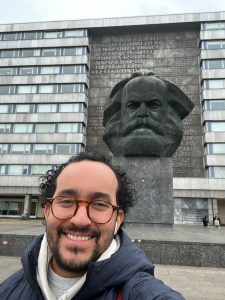
Vinícius Venâncio
Vinícius Venâncio holds a PhD (awarded in 2024) and a Master’s degree (awarded in 2020) in Social Anthropology, both from the University of Brasília. He is currently undertaking a postdoctoral fellowship at the Institute of African Studies at the University of Leipzig. Since 2016, he has conducted research in Cape Verde, analyzing topics such as migration, tourist flows, national identity and material culture from an intersectional perspective. He is the author of the book “O comércio da saudade: Tourism and the Production of Genuinely Cape Verdean Souvenirs on the Island of Santiago.”
About the Seminar
In Cape Verde, a society that emerged in the wake of the Atlantic slave trade, Crioulo, an Afro-Portuguese creole language, became both the mother tongue and a symbol of Cape Verdean national identity. Although mestizaje and creole identity are now central to the Cape Verdean national self-concept, this has not always been the case.
This talk examines how Cape Verdeans developed a positive valuation of Crioulo during the Portuguese colonial period, and how the language functions both as a means of differentiation and of unity vis-à-vis other West African populations. Grounded in extensive ethnographic research, the empirical and theoretical focus of the talk is on the mechanisms through which Crioulo fosters a sense of belonging and, consequently, produces forms of exclusion.
This talk offers a lens through which to examine other postcolonial and postimperial contexts grappling with legacies of peripheralization and exploitation, including the Balkans.
Join Zoom Meeting
https://us02web.zoom.us/j/88989643663?pwd=VnZTOWRmdnl0WEZIdTczc1paZWtkdz09
Meeting ID: 889 8964 3663
Passcode: 328897
Fellowship
Fellowships are supported by OSF Western Balkans, ERSTE Foundation and Rockefeller Brothers Fund.
UNIRI The Moise Palace: Cres Island
An education center of the University of Rijeka. A five-hundred-year-old patrician townhouse and the largest Renaissance palace on the Croatian islands. A venue and forum for various scientific and research activities, it welcomes visiting academics, students and scholars.