
EU Enlargement Reform: How to Unblock Accession Talks and Strengthen European Defence
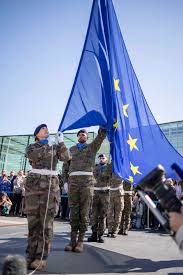
A new GEO-POWER-EU report sets out how the EU can end veto blockages in accession negotiations without changing the Treaties, and how it can integrate candidate countries’ security and defence more coherently.
The problem: 27 vetoes at every step
Joining the EU involves dozens of intermediate decisions, such as opening negotiation clusters, setting benchmarks and closing chapters. Each of these currently requires the agreement of all 27 member states. As a result, every government holds a veto at every step, and several have used it to pursue disputes unrelated to a candidate’s reforms. For citizens in the Western Balkans, Ukraine, Moldova and Georgia, the process therefore appears unpredictable and unfair.
The solution: a three-track model without Treaty change
Rather than abolishing unanimity altogether, which sceptical member states oppose, Nikolaos Tzifakis (University of the Peloponnese) proposes that accession decisions be grouped into three tracks according to what is at stake:
- Constitutional-Sovereignty Track for politically sensitive issues (rule of law, foreign policy, EU institutions and bilateral questions): decisions by a large majority of 20 of 27 member states, with an emergency brake allowing any country to refer a vital national concern to EU leaders.
- Accession Terms and Conditions Track for agriculture, cohesion funds and the EU budget: the same large majority, but without the emergency brake, as these arrangements are time-limited.
- Regulatory Alignment Track for technical assessments of whether candidates have adopted EU rules (single market, competitiveness and green agenda): the Commission’s assessment is adopted unless member states reject it within 90 days.
This model preserves the strongest national safeguards for the most sensitive questions, while making technical stages less vulnerable to individual vetoes. Importantly, unanimity at these intermediate steps is not required by the EU Treaties. It is an established practice recorded in each candidate’s negotiating framework, and the Council can therefore change it by a single decision.
Security and defence: from fragments to a coherent pathway
Defence has become the fastest-growing area of EU integration, yet enlargement policy has not kept pace, argues Sonja Stojanović Gajić (University of Rijeka). Security issues are already part of accession negotiations, but they are dispersed across different chapters and assessed in isolation. Her analysis identifies three gaps.
Democratic safeguards are insufficiently monitored. Intelligence services, surveillance and defence procurement receive little scrutiny, although they are particularly exposed to political capture and corruption. Candidates may also align formally with EU foreign policy while maintaining security ties with EU competitors. Serbia, for example, has a cooperation agreement with Russia’s FSB, and China is its largest arms supplier.
There is no clear pathway into European defence. Candidates’ access to EU defence instruments consists of separate entry points rather than a structured, staged process. This is especially significant for candidates that are not pursuing NATO membership.
The EU is missing opportunities to strengthen its own readiness. The EU urgently needs more ammunition, drones, resilient supply chains and capacity to move forces across the continent. Candidate countries could contribute to all of these. The Western Balkans host around 200 defence companies, and Bosnia and Herzegovina alone could produce an estimated 500,000 artillery shells a year. The region also offers transport routes, training grounds and logistics relevant to military mobility. Yet while Ukraine and Moldova already participate in several EU defence initiatives, no EU military mobility funding has reached Western Balkan projects, and these capacities remain outside EU defence planning.
To address these gaps, she proposes a Security, Defence and Preparedness Convergence Roadmap for every candidate. It would set common benchmarks for democratic oversight of security institutions, defence readiness in line with NATO standards, genuine strategic alignment and whole-of-society resilience, with a role for independent media and civil society.
Progress would bring tangible benefits before membership: training and capability-building, closer cooperation with the European Defence Agency and PESCO projects, observer access to EU defence formats, European Peace Facility support, joint procurement and links to European defence supply chains. Backsliding would halt or reverse these benefits, as when the EU suspended €30 million in support to Georgia in 2024.
The Roadmap builds directly on the three-track model. Where an existing EU defence instrument already has its own rules for involving third countries, those rules would continue to apply. Where a new Council decision on a candidate’s defence integration is needed and no such rules exist, it would be taken under the Constitutional-Sovereignty Track, by a large majority with an emergency brake, rather than by creating a new unanimity requirement.
More in the report
The report also sets out priorities for the rule of law, economic convergence and brain drain, and the energy transition. It calls for a principled membership framework in which new members join as equals, without second-class status.
Full reference
Tzifakis, N., Vogel, T., Stojanović Gajić, S., Fidanovski, K., Jovanović, B., Prodromidou, A., & Manoli, P. (2026). Reforming EU Enlargement Governance and Advancing a Principled Gradual Integration: A Three-Track Decision-Making Model and Priority Accession Reforms (GEO-POWER-EU Deliverable D2.5). GEO-POWER-EU / University of the Peloponnese. https://doi.org/10.5281/zenodo.22898659
Read the full report: https://geo-power.eu/wp-content/uploads/2026/09/D_2.5-EU-Enlargement-Reform-Paper-2.pdf
Photo: © European Union 2014 – European Parliament